
Five-year-old Enid is a German Shorthaired Pointer who came for a course of Massage Therapy with me after her owner Leah noticed the appearance of a zig-zag pattern in the fur running down the back of her neck.
Enid is a really active dog who regularly takes part in a variety of canine activities including Mantrailing and Scentwork. Her guardian is a Dog Professional and so Enid’s days are packed full of fun and variety and she often accompanies her owner during her working day.
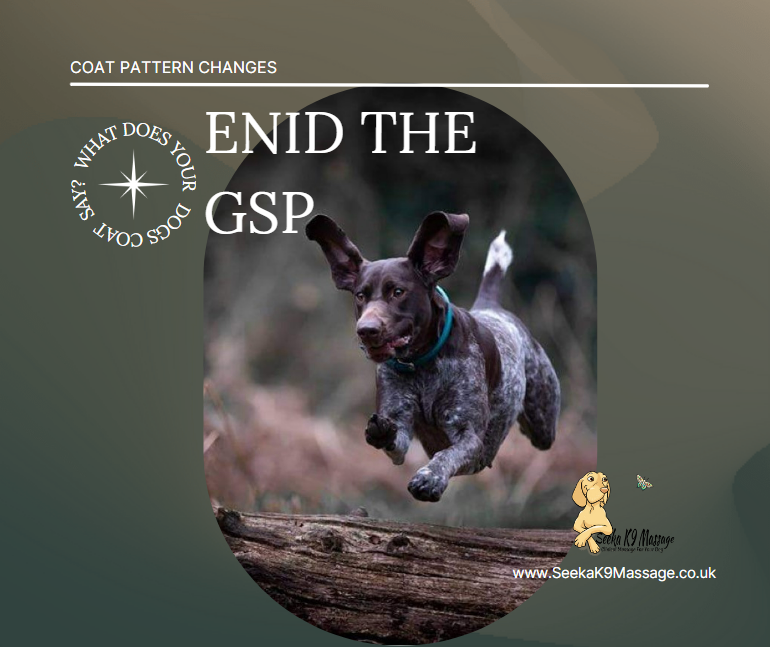
Although Leah hadn’t noticed any significant signs of stiffness or mobility difficulties, she was keen to address any potential problems at a subclinical stage before they escalate into chronic conditions. Leah wanted to make sure that Enid wasn’t experiencing the type of myofascial pain that is commonly present alongside these typical physical appearance changes in dogs fur.
To arrange an appointment with me, Enid’s owner was first required to seek the approval of her Vet (my Vet Consent form can be downloaded from my website and taken to your vet). Enid’s Vet, James noticed that there was indeed some muscular tension present when he examined her and this was documented on the consent form I received.
Enid is a dog who is comfortable around people and generally happy to accept physical contact, which is not always the case with new clients and it’s quite common that we need to take some time to build the dogs confidence around massage, which helps them relax during treatment.
Initial Consultation
During a typical first session I will observe how your dog moves, and I will be looking for gait irregularities which may also help me to identify possible issues. I will look at your dogs posture preferences, I’ll investigate how they sit and if any limbs are abducted or adducted, and I’m looking to see if your dog is able to hold a position without needing to frequently readjust or shuffle around, this type of information will provide the first clues for identifying myofascial issues in your dog, and I plot these findings in diagram form.
I looked carefully at the Enid’s appearance, and I could clearly see the coat pattern change which was the reason for Enid’s visit. To be able to assess for further changes, I captured a few images of it, keeping visual and written notes can really assist when it comes to monitoring the progress of a client.

I use advanced palpation skills to assess the musculature, reading the soft tissue with my fingers to feel for tears and tightness which will inform me of underlying issues. Putting all the pieces of the puzzle together can help me to identify issues that your dog isn’t able to tell us about (if only our dogs could speak to us!).
Enid’s neck felt generally tense with a greater degree of hypertonicity on the left side accompanied by adhered fascia over the left dorsal border of her scapula which correlated with the zig-zag patterning over her cervical region.
I worked Enid’s body as a whole because this enabled me to address any areas of overcompensation throughout her body, this is combined with more targeted work on those areas where soft tissue injuries were identified.
In cases where the animal’s issues are very painful, I may choose a less direct approach to gradually work into the problem at a deeper level and all therapists trained in The Lenton Method are able to use both direct and indirect methods of myofascial release accordingly to modify treatments to suit each individual dog beneath our hands.
When you notice changes occurring in the appearance of your dog’s coat, it’s really fascinating and you may wonder what causes these types of changes, so we’ll take a deeper look at that now. Beneath our dogs fur we have a layer of superficial connective tissue, a complete bodysuit of fascia. At an even deeper level, fascia coats nerves and bones, and it wraps individual muscles and groups of muscles too. Fascia plays vital functions, allowing the muscles to slide and glide over each other which is needed for free, unrestricted movement. Fascia has proprioceptive functions, containing nerve endings, the fascia is the environment in which the nervous system lives, when soft tissue injuries occur the fascia can become dysfunctional, its properties can quickly change from being smooth, supple, and slippery to becoming sticky, tight and dehydrated. Tight fascia will become bound and adhered, losing its elasticity and wrapping the muscles tightly meaning that they will now be less able to slide over each other to enable free movement to occur. With the constriction of the soft tissue, we would also see that there is less ability for fluids such as lymph and blood to move through the muscles, decreased perfusion will result in toxic build-up leading to painful trigger points and a lack of fresh nutrients to help with the repair process.
These changes beneath the skin can manifest as the type of coat pattern changes that were noticed on the surface of Enid’s skin, where dysfunctional fascia pulls the tissue in odd directions. We sometimes also see changes in the condition of the fur in these areas, we may notice dry or coarse patches of fur, scurf or dander, and this happens when the circulation to an area is affected and the resulting lack of nutrients to the area may show in the condition of the coat.
When we have adhesions like this, your dog may also experience myofascial pain, the tight fascia may agitate or sensitize nerve endings resulting in increases in nociceptive activity, where even the lightest of touch can produce a pain response.
Treatment
During Enid’s treatment I used Swedish Massage Techniques to warm up and prepare the muscles for the deeper targeted work which The Lenton Method employs. The protocols of The Lenton Method provides me with the skills to be able to directly release the Myofascial tissue combined with deep tissue work to remodel scarring, realigning and restoring muscles to enable them to function correctly again.
During massage, I will be increasing the supply of blood and fluid into the area that I’m working on and this can release restrictions and potentially alter the way that pain signals are being processed, massage can be very helpful in addressing nociceptive pain.
The fibres that hold the body in place can be moved and manipulated, helping to improve mobility and address stiffness and bound or adhered tissue.
Result after three sessions

After three Massage Treatment sessions, the adhesions and tension seen on her initial visit was relieved and greatly improved. The fur on Enid’s neck was now smooth and glossy, there was no evidence of the zig-zag coat pattern that was seen on her first visit, it had completely disappeared.
Owner Leah was really surprised to see Enid’s coat had change so quickly and her vet was also very interested in the changes that were achieved by using The Lenton Method.
Mair Franklin, Seeka K9 Massage, West Midlands.
Canine Massage Guild Member
RESULTS YOU CAN SEE AND YOUR DOG CAN FEEL IN 1-3 SESSIONS.
Canine Massage Guild
Contact me
If you would like to discuss your dog’s issues to see if they may benefit from Clinical Canine Massage, please get in touch with me via email:
Or visit my website: www.seekak9massage.co.uk
Or find me on facebook: Seeka K9 Massage