
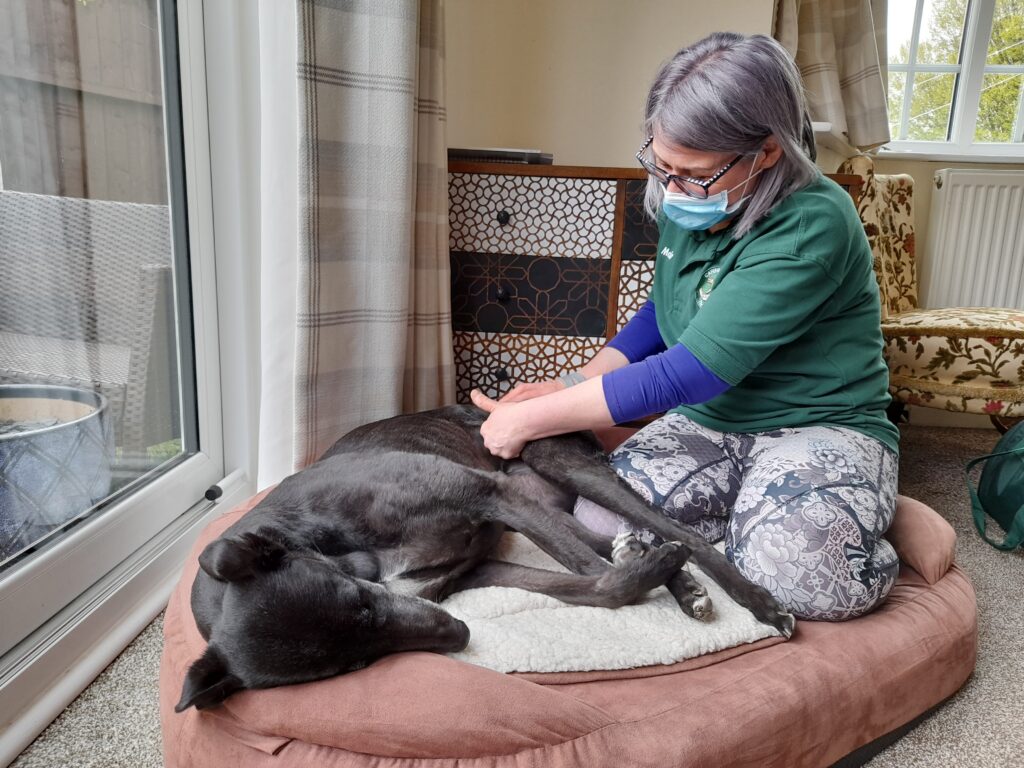
On Bank Holiday Monday I had the pleasure of spending a few hours with the Hall Green Greyhound Trust at their Kennel Open Day. I was offering free Muscular Health Checks and the chance to discuss adaptions that can be made to help the hounds navigate their Daily Activities with greater ease and reduced risk of injury.

Greyhounds are such an interesting breed, with around 55% of their total bodyweight made up of muscle, which means they have around 10% greater muscle mass than their fellow dog breeds. The Greyhounds elite sporting anatomy puts them at greater risk from muscular injury, and it’s really interesting to note that there are specific areas and injury types that are quite common in Greyhounds, particularly those with a racing past.

Students of The Canine Massage Therapy Centre study for two years on an intensive programme in which we develop advanced palpation techniques and canine anatomical knowledge. Our training gives us the opportunity to gain hands-on experience of the feel and texture of the musculoskeletal system of a large range of breeds…the more dogs we feel, the greater our sense of perception and fingertip sensitivity develops, which enables us to accurately assess and read the soft tissue fibres of the body and its responses to our touch.

The Greyhound is a particularly interesting breed because of its high ratio of muscle tissue to bodyweight, combined with its smooth coat and fine skin, so the structures of the Greyhound are easily palpable for students which makes them ideal teaching dogs. Students of The Clinical Canine Massage Practitioner Programme usually visit the local Greyhound Trust Kennels for practical lessons because these dogs offer amazing study opportunities, and they often carry injuries from their racing days that can be helped during our visits.
Many ex-racing Greyhounds pick up strains and sprains from over exertion, and these are often in common specific areas which correlate to the anticlockwise direction they are always raced around the track. When cornering in an anticlockwise direction, it is the left forelimb and right hindlimb that takes the most stress and we commonly see repetitive issues along this diagonal.
A common Greyhound injury is found in the Gracilis muscle which is a close relation to your dogs hamstring muscle group, found on the inner thigh, the Gracilis muscle provides propulsion, it also works to flex and extend your dogs stifle (knee) joint. This muscle often gets strained in Greyhounds when it isn’t warmed up and prepared for rapid action/acceleration, for example, when the Greyhound accelerates from a cold standing position to reach speeds of up to 45 mph.
One of my student case studies was with a beautiful five-year-old retired racing Greyhound called Piper. During my initial consultation I observed Pipers gait and posture before palpating her muscles to assess the tone, texture, temperature and tenderness of her soft tissue.
During our first consultation a detailed history is recorded and Pipers guardian was unaware of any issues with mobility or pain relating to Pipers daily routines and activities. However, when I palpated Pipers muscles, I found that she had bilateral scar tissue in her lumbar Iliocostalis and bilateral strains of the Gluteal muscles too. There was some sensitivity bilaterally of the Tensor Fascia Lata and both Gracilis muscles.
Results you can see and your dog can feel in just one to three sessions
At our third massage session Pipers guardian told me that they needed to install new barrier fencing at the bottom of their garden because Piper has started to jump over the low fence that was currently in place. This was a new behaviour for Piper and it became apparent to Pipers owner that her dog wasn’t actually able to jump over obstacles prior to receiving massage treatment with me.
Dogs can be quite stoic about pain and discomfort, and they aren’t able to tell us in words how they feel or when they are experiencing pain in the body, and this is another benefit of booking regular maintenance massages for your dog. Your massage therapist has trained to develop heightened sensitivity in their fingertips which enables us to accurately read the tissue and detect tears, areas of focal point tension and scar tissue within the muscle fibres. Scar tissue will always be there once it has formed, but we can help to remodel it, releasing adhesions and myofascial restrictions, restoring the smooth slide and glide function of the muscles, thus improving mobility and reducing stiffness and pain.
I think Greyhounds are absolutely amazing creatures, and I’m excited to have the opportunity to offer some voluntary assistance to those beautiful souls who have found themselves in Kennels at my local Greyhound Trust whilst they await fantastic new forever homes. Treating dogs who may have some body sensitivity or allodynia due to myofascial pain could even help to make a difference to the dogs chances of finding a kind person to offer them a home. If myofascial pain is addressed using The Lenton Method, it could make the difference between a dog who is comfortable to be petted and one who avoids petting because it induces pain.
The Lenton Method treats muscular and myofascial conditions in dogs of all ages and across all breeds. In Clinical Trials conducted by The University of Winchester, The Lenton Method produced tangible improvements in the condition of 95% of the 527 dogs treated by Canine Massage Guild Therapists in the Study. This peer reviewed paper can be seen in the Vet Record Publication via this link: Effect of massage therapy on pain and quality of life in dogs: A cross sectional study – Riley – 2021 – Veterinary Record – Wiley Online Library
If you think you could provide a loving home for an amazing Grey, check out the Greyhound Trust.
Contact me
If you would like to discuss your dog’s issues to see if they may benefit from Clinical Canine Massage, please get in touch with me via email: clinic@seekak9massage.co.uk
Or visit my website: www.seekak9massage.co.uk
Or find me on facebook: Seeka K9 Massage