
The skin, its glands and hair, the claws and foot pads, make up your dogs Integumentary System, so basically, it’s your dog’s outermost layers…the stuff that keeps his insides on the inside, and prevents things in the external environment from entering or invading your dog’s body.
The skin is the largest organ of the body and in the average medium-sized 30lb dog, the skin would cover about half a square yard and weigh approximately 3lbs (Lewis, 2020).
The job of the skin is to provide an efficient waterproof, protective, external defense, keeping infections out of the body whilst also acting as an organ of perception (capable of detecting even the lightest of touches and other external stimuli).
Waste is eliminated through the skin via sweat glands, and temperature is modulated in this way too, although in dogs it is generally the footpads and tongue that are the most efficient areas for dissipating heat.
The external covering of the body needs to be flexible enough to allow your dog to move freely yet strong enough to retain its shape and form, it’s important to have some appreciation of the critical role skin plays in the wellbeing of our animals, or any other living mammal for that matter.
The most superficial layer of the skin is the Epidermis and deep to that we have the Dermis, followed by the Subcutaneous layer or Superficial Fascia layer.
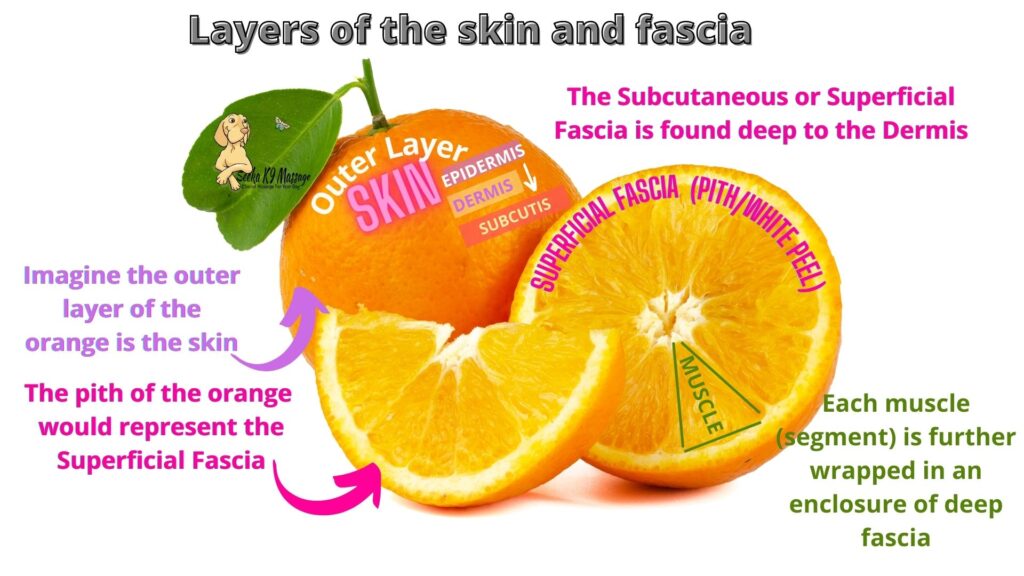
The Superficial Fascia is a layer of loose connective tissue containing fat cells in which blood vessels, nerves, white blood cells and other immune system cells live. The superficial fascia separates the skin from the muscles, which in healthy tissue, allows them to smoothly slide across each other. This layer of connective tissue also plays a role in heat regulation, circulation and the flow of lymphatic fluid.
Fascia is the environment in which the nervous system lives, so keeping it hydrated, supple and healthy is important. When your dog has pain or an injury, he may restrict his movement in the sore limb, which can result in the fascia becoming adhered, dysfunctional and tight, as though it were wrapping your dog’s muscles tightly in a layer of clingfilm.

Deep Fascia is dense connective tissue and it individually surrounds the muscles but also wraps groups of muscles into functional compartments, the deep fascia helps muscles in their action by maintaining tension and pressure.
Your dog’s skin is home to sensory nerves which detect the sensations of pressure, pain, tension, irritation and temperature and this information is relayed to the Central Nervous System which will send efferent impulses back to the affected area via the motor nerves with instructions to react to the stimuli if needs be, for example, if the skin on your dog’s paw came into contact with something sharp, a sensory receptor would shoot a message off to the brain and an instant motor message would return to recoil the paw from the sharp object to avoid injury.
Dysfunctional fascia can also cause the body’s pain receptors to become over sensitive, and pain signals can be sent in response to stimuli that wouldn’t ordinarily cause pain to be experienced.
Adhered fascia and soft tissue can also result in what we call “tension patterns”, and these are physical changes that can be noticed on your dog’s coat, like colour or texture changes, dry or oily patches in the fur, and even flicks or swirls appearing in your dogs coat that weren’t there before, but that’s a whole other blog and one that I intend to cover in more detail as a topic of its own.

How massage can improve your dogs external and underlying soft tissue
Pain
When I massage your dog, I will be increasing the supply of blood and fluid into the area that I’m working on and this can release restrictions and potentially alter the way that pain signals are being processed. Massage can be very helpful in addressing nociceptive pain.
Mobility
The fibres that hold the body in place can be moved and manipulated, helping to improve mobility and address stiffness and bound tissue.
Coat Health
Massage increases the circulation of blood and oxygen around the body which can bring about an improvement in your dog’s skin and coat, freeing up congestion will also allow for improved distribution of nutrients to your dog’s coat.
Identifying Problems Early
Regular massage sessions will mean that I am able to identify possible problems or health issues such as lumps and bumps, during treatment I will be assessing your dog’s condition as I work, I’ll be monitoring tension in the soft tissue, texture changes, sensitivity or heat changes which can help me to identify if an issue is present for your dog that would warrant a quick vet check. When we are able to notice small changes and intervene early, we may see better outcomes than if issues aren’t noticed until they’re at a chronic stage.
Stress Relief
If your dog finds contact a pleasant experience, then massage will release feel good hormones and promote comfort and an improved mood state. However, it’s quite normal for dogs to be significantly less settled during their first few massage experiences, but giving them time and choices during treatment can help them to settle into the treatment and feel much more comfortable with the whole thing. As well as being a Clinical Canine Massage Therapist, I am a Tellington Ttouch Practitioner and Behaviourist so I have a really good understanding of what your dog will be communicating to me during our session, and I will be working with what your dog is telling me the whole time.
Reduced Sensitivity to Touch
Restricted, dysfunctional, adhered fascia can cause allodynia or hyperalgesia which is a heightened sensitivity to pain, and you may notice that your dog pulls away from you or avoids letting you pet or get close.
If your dog is experiencing wide-radiating myofascial pain, even the lightest touch may cause discomfort, but massage therapy, and specifically The Lenton Method using direct and indirect myofascial release techniques, can greatly improve this for your dog.
When pain is resolved, you may see that your dog starts wanting to be closer to you again, and may actively seek out contact with you instead of avoiding it.
Addressing myofascial pain in your dogs body and releasing tension can often result in a dog who is much more settled during routine husbandry, Veterinary visits and Grooming sessions too.
References
Lewis T (2020) Biology of Dogs From Gonads through to Guts to Ganglia, USA, DogWise Publishing.
News about future events:
I will be one of the Therapists offering free muscular health checks on The Canine Massage Guild stand at DogFest which will be taking place at Ragley Hall in Warwickshire on 28th & 29th May 2022, if you’re coming to the event be sure to visit The Canine Massage Guild.
Contact me
If you would like to discuss your dog’s issues to see if they may benefit from Clinical Canine Massage, please get in touch with me via email: clinic@seekak9massage.co.uk
Or visit my website: www.seekak9massage.co.uk
Or find me on facebook: Seeka K9 Massage